Tankers for the transport and distribution of drinking water
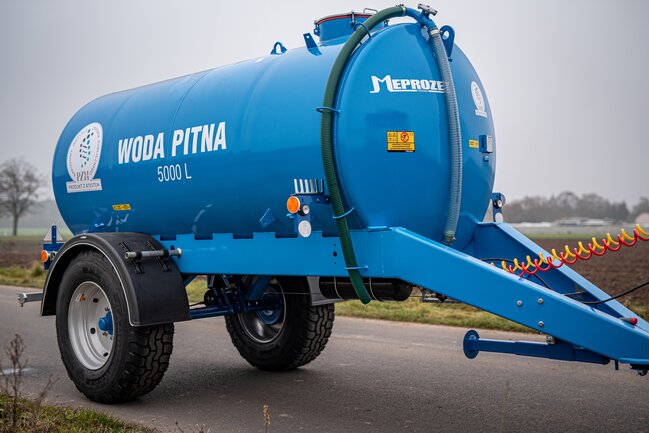
Tankers certified by the National Institute of Hygiene (PZH) have gained considerable popularity both in Poland and abroad.
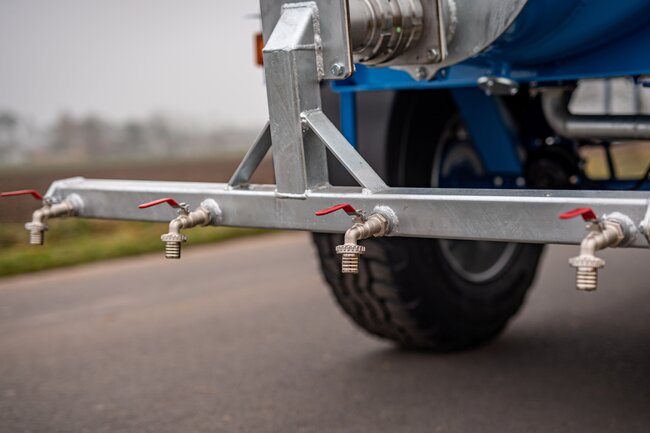
The attractive price is the result of the tank being manufactured from ordinary carbon steel, which is considerably cheaper than the stainless steel commonly used in this type of construction. The tank then receives a food‑grade coating during the hot‑dip galvanising process. The exterior is finished with an attractive polyurethane paint in the customer's chosen colour. The standard equipment of each unit comprises road radial tyres, a lower transport coupling, a two‑line pneumatic braking system with a manual parking brake, and an electrical lighting system. The tank is filled via the top fill hatch with ladder access. Water distribution is effected using a draw‑off bar fitted with at least four outlets. It is worth emphasising that, since September 2022, Meprozet holds European type approval under Regulation (EU) No 167/2013. As a result, drinking‑water trailers can be registered in any Member State of the European Union.
These products are offered in three capacity versions: 3, 4 and 5 m³. It is also possible to prepare any Meprozet solution for the transport of drinking water — including slurry tankers, hook‑lift containers and rigid lorry bodyworks. This approach provides a wide range of available capacities from 2.3 up to 30 m³ and a rich set of functionalities, allowing the tank to be adapted to the customer's individual requirements. Given that the unit is used mainly in emergency situations, adapting it for alternative uses constitutes an additional benefit for operators. The simplest, most intuitive option is to employ the tank wherever water transport is required and to use it for non‑potable tasks as needed. The Kościan manufacturer offers an inexpensive upgrade enabling the tank to be used for watering urban greenery. For this purpose the vehicle is fitted with a small hydraulically driven centrifugal pump and a garden hose terminating in a nozzle or lance for watering elevated floral displays. Where required, the hose may be wound on to a drum with an automatic rewind option.
An interesting option is to equip standard drinking‑water tankers with an animal watering kit. Such a vehicle is then fitted with troughs mounted at the rear and along the sides of the tank. These troughs are fitted with float fill valves, ensuring the water level is maintained automatically. This solution is of interest to, for example, zoological gardens, stud farms and other animal‑rearing enterprises.
(source: Technika Komunalna 6/2022, p. 48)